
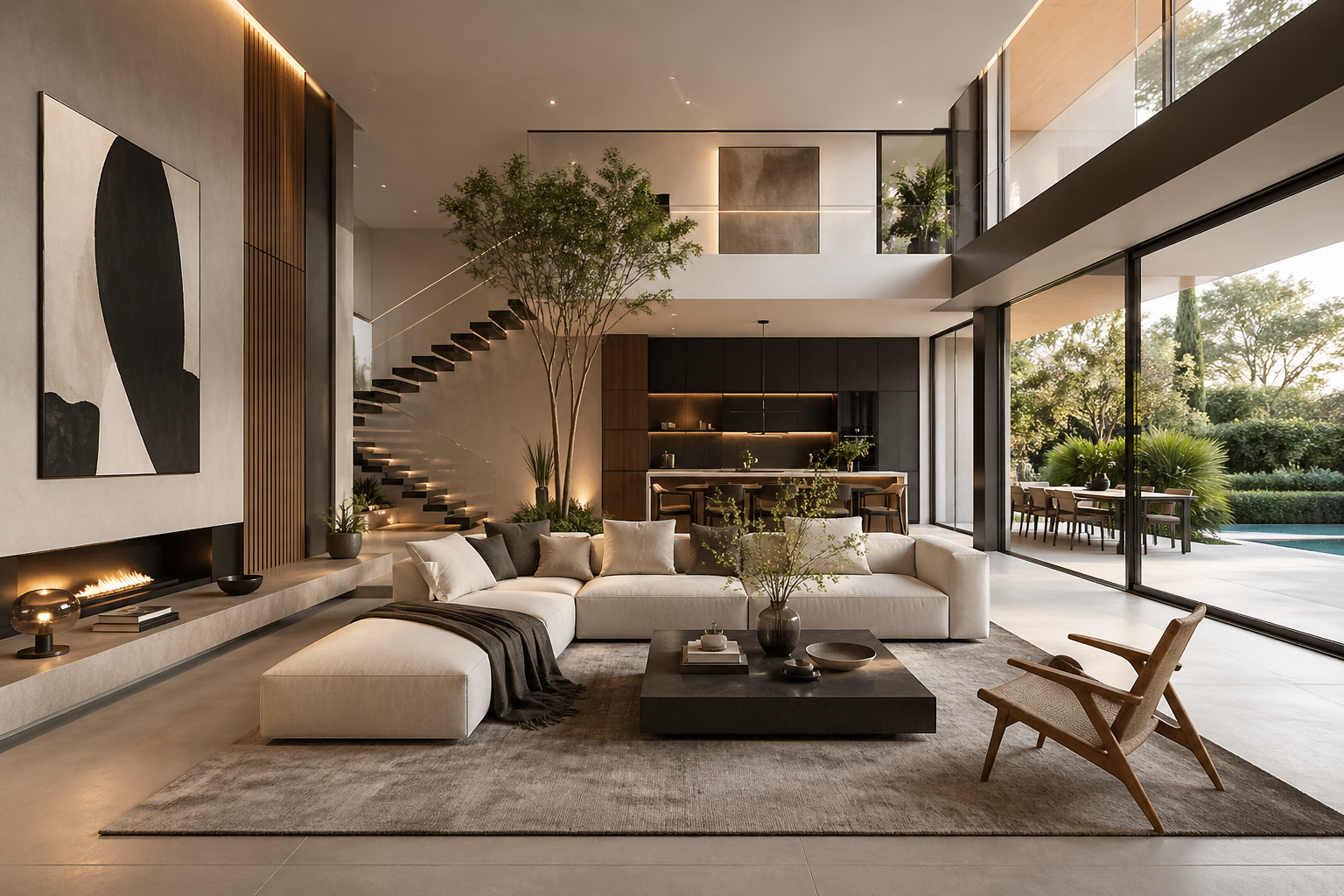
In 2026, the most influential shift in luxury architecture and interior design is the rise of quiet luxury, a movement defined not by excess, but by precision, restraint, and enduring quality. High-end clients are moving away from trend-driven aesthetics and toward timeless architectural design that prioritises proportion, craftsmanship, and spatial experience. This is not about ostentation or surface-level glamour, but about creating homes that feel intrinsically right, spaces that improve with time rather than date.
This evolution is particularly evident in bespoke residential architecture, where layouts are increasingly designed around lifestyle flow rather than formal convention. Open-plan living is being refined into intentional zoning, private retreats, wellness spaces, and multi-functional environments that support modern living without compromising elegance. The question is no longer how large a room can be, but how well it serves the people who inhabit it.
What Quiet Luxury Actually Means in Residential Design
Quiet luxury resists simple definition because it is fundamentally about absence, about what is left out rather than what is added. It is the opposite of conspicuous consumption. Where traditional luxury might showcase rare materials or elaborate ornament, quiet luxury focuses on perfect proportion, flawless execution, and spaces that feel calm and complete.
In practice, this means prioritising authenticity over imitation. Natural stone is used honestly, timber is detailed to reveal its character, and finishes are chosen for their intrinsic qualities rather than their ability to mimic something else. The result is architecture that feels grounded, unpretentious, and deeply considered.
This approach also values longevity. A home designed with quiet luxury in mind will not feel outdated in five years because it is not chasing trends. It draws on enduring principles of good design, adapted thoughtfully to the site, the climate, and the client’s needs.
How Detailing Defines Quality
In high-end interior design, detailing has become the new statement. Seamless joinery, concealed storage, and integrated lighting systems create clean, uninterrupted lines, allowing materials and form to take precedence. This level of execution is what distinguishes true luxury home design from standard developments.
The difficulty lies in achieving simplicity. A minimalist aesthetic is deceptively complex to execute well because there is nowhere to hide imperfections. Every junction, every transition between materials, every door swing must be resolved with precision. Working with a registered architect through the NSW Architects Registration Board ensures this level of rigour is maintained throughout the design and construction process.
This attention to detail extends beyond the visible. Acoustic separation between rooms, thermal performance, the quality of hardware, these elements are rarely photographed but profoundly affect how a home feels to live in. Quiet luxury is as much about what you experience over time as what you notice on first arrival.
Sustainability as a Core Principle
Sustainability is no longer an add-on, it is embedded in the design process. Clients are prioritising energy-efficient architecture, passive cooling strategies, and locally sourced materials that align with both environmental responsibility and long-term property value. This is not greenwashing or tokenism, it is a fundamental shift in how we think about building.
Passive design principles, orientation to maximise natural light and cross-ventilation, thermal mass to moderate temperature swings, these strategies have been understood for decades but are now being implemented with far greater sophistication. The goal is to create homes that require minimal mechanical intervention to remain comfortable year-round.
Material selection also plays a significant role. Choosing materials with low embodied energy, specifying finishes that will age gracefully rather than require replacement, designing for adaptability so spaces can evolve with changing needs, all of these decisions contribute to a more sustainable outcome. The most sustainable building is one that lasts, both physically and in the affection of its occupants.
Personalisation and the Role of the Architect
Another defining element of quiet luxury is personalisation. Today’s most sought-after spaces are highly curated, reflecting the client’s identity through custom interior solutions, art integration, and one-of-a-kind finishes. This is not about following a predetermined aesthetic, but about developing a design language that is specific to the client and the site.
The role of the architect in this process is not to impose a signature style, but to listen carefully and translate the client’s needs and aspirations into built form. This requires an understanding of how people actually live, how they move through space, what rituals and routines shape their daily experience. Our services are structured around this collaborative process, working closely with clients from initial concept through to completion.
Personalisation also means resisting thetemptation to design for resale. A home conceived primarily as an investment vehicle will inevitably feel generic. A home designed for a specific client, on the other hand, will have character and integrity that transcends market trends. Paradoxically, this often makes it more valuable in the long term.
The Future of Luxury Residential Design
As the market matures, the definition of luxury continues to evolve. It is no longer about what is seen at first glance, but what is experienced over time, spaces that feel effortless, refined, and built to last. This is the future of design, and it represents a welcome shift away from excess toward essentialism.
The challenge for architects and clients alike is to maintain this standard of quality and thoughtfulness in an industry that often rewards speed and superficiality. It requires patience, expertise, and a willingness to invest in the design process. But the result is a home that genuinely enhances daily life, a space that feels like a retreat rather than a showpiece.
Quiet luxury, then, is not a style or a trend. It is an approach to design that values substance over spectacle, experience over appearance, and lasting quality over immediate impact. It is architecture at its best, thoughtful, rigorous, and deeply humane.
If you are considering a residential project that prioritises enduring design quality and thoughtful execution, we would welcome the opportunity to discuss how we might work together. You can learn more about our practice and get in touch with Maya Sternberg Architects here.