
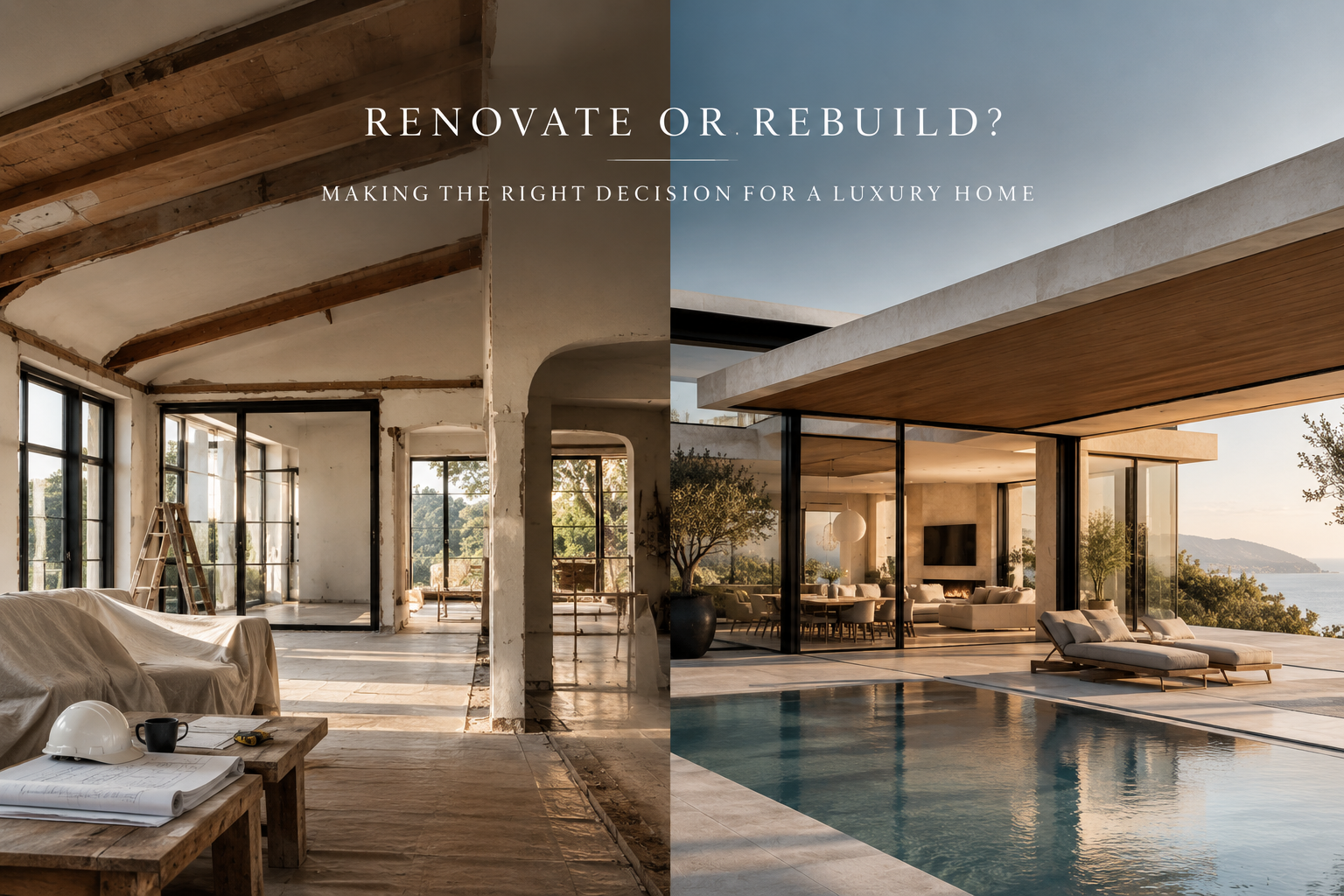
Understanding the Renovate or Rebuild Decision
When homeowners consider a major property transformation, the question of whether to renovate or rebuild often emerges as the most important decision they’ll make. In residential architecture, the answer is rarely determined by appearance alone. A successful decision requires careful consideration of the property, its structure, location, planning opportunities, and the way the homeowners want to live.
This decision is particularly significant for those investing in high-end residential design. The right approach can unlock the full potential of a property, while the wrong one can lead to compromises that limit how well the home serves its occupants over time.
When Renovation Makes Sense
A high-end home renovation can preserve the character and history of an existing property while introducing a completely new level of functionality. Thoughtful alterations can improve spatial flow, natural light, entertaining areas, and connections between indoor and outdoor spaces without losing the qualities that make the original home distinctive.
There are situations where the existing structure provides a strong foundation to build upon. If the home’s bones are sound, if its orientation takes advantage of views and solar access, and if its character contributes meaningfully to the design, renovation can deliver exceptional results. The existing building envelope becomes a framework within which contemporary living can unfold.
Renovation also makes particular sense when working with heritage properties where conservation overlays or local character considerations shape what’s possible. In these contexts, a carefully considered renovation respects the existing fabric while introducing modern amenity and spatial quality.
When Rebuilding Offers More
However, there are situations where new home construction can provide greater long-term value. If an existing structure significantly limits the layout, orientation, ceiling heights, natural light, or relationship with the landscape, a new architectural solution may offer considerably more freedom.
Starting fresh allows for a ground-up response to site conditions. Solar orientation, prevailing breezes, views, privacy, and the topography of the land can all be addressed from first principles. The result is often a home that feels naturally placed within its context, rather than one that has been adapted over time.
Rebuilding also provides the opportunity to incorporate contemporary building technologies and environmental performance standards from the outset. Thermal mass, insulation, glazing selection, and passive design strategies can be integrated into the fabric of the building in ways that are difficult to achieve through renovation alone.
Structural and Planning Considerations
Sometimes the existing structure itself makes the decision clear. If there are significant structural issues, if the building footprint is poorly positioned on the site, or if the existing layout fundamentally conflicts with how the space needs to function, the cost and compromise involved in renovation can outweigh its benefits.
Planning controls also play a role. Depending on the property’s location and zoning, a new dwelling may be subject to different floor space ratio calculations, setback requirements, or height limits than an alteration and addition. Understanding these constraints early helps inform the renovate or rebuild decision with clarity.
The Design-Led Approach
For homeowners investing in bespoke residential architecture, the goal should not simply be to create a larger or newer property. It is about creating a home that responds precisely to its site, lifestyle, and future needs. This is where working with an experienced architect becomes invaluable.
Early design advice can identify opportunities, uncover limitations, and establish a clear direction before significant investment is made. A registered architect, working under the standards set by the NSW Architects Registration Board, brings both technical knowledge and design vision to this process. The result is a decision grounded in both practicality and aspiration.
Whether renovating or rebuilding, the strongest luxury homes begin with the same principle: design should serve the way you want to live. The question is not which option is inherently better, but which approach allows the architecture to most fully support the lifestyle, comfort, and long-term enjoyment of the homeowners.
Making Your Decision
The renovate or rebuild decision is never one-size-fits-all. It depends on the specific circumstances of the site, the condition and qualities of the existing building, the planning context, and the homeowners’ vision for how they want to inhabit the space.
What matters most is approaching the decision with clear eyes and informed judgment. That means understanding the structural reality of what exists, the opportunities offered by the site, the constraints imposed by planning controls, and the design possibilities inherent in each approach.
It also means being honest about how the home needs to function. If the existing layout can be adapted to support the way you live, renovation may deliver everything you need while retaining the character you value. If the existing structure stands in the way of the home you’re trying to create, rebuilding may be the more honest and ultimately more satisfying path.
The range of services offered by a residential architecture practice should support this decision-making process from the earliest stages. Feasibility studies, site analysis, and concept design work all help clarify which direction offers the most potential.
If you’re weighing up whether to renovate or rebuild your Sydney home, we’d welcome the opportunity to discuss your project. At Maya Sternberg Architects, we bring a calm, considered, and design-led approach to residential architecture. Learn more about our practice and how we can help you make the right decision for your property.